

Every horse is a heat source.
The manure from an average-sized horse provides fuel for roughly 4 kW, around the clock.
- Per horse
- approx. 4 kW
- 40 horses
- approx. 160 kW
- Heated area, 40 horses
- approx. 2,500 m²
Approximate values according to Biotherm, for an average-sized horse and a facility with 40 horses.
The heat goes to stables, riding arenas and homes. The manure becomes heat on site, with no landfill and no transport.
The manure can be wet.
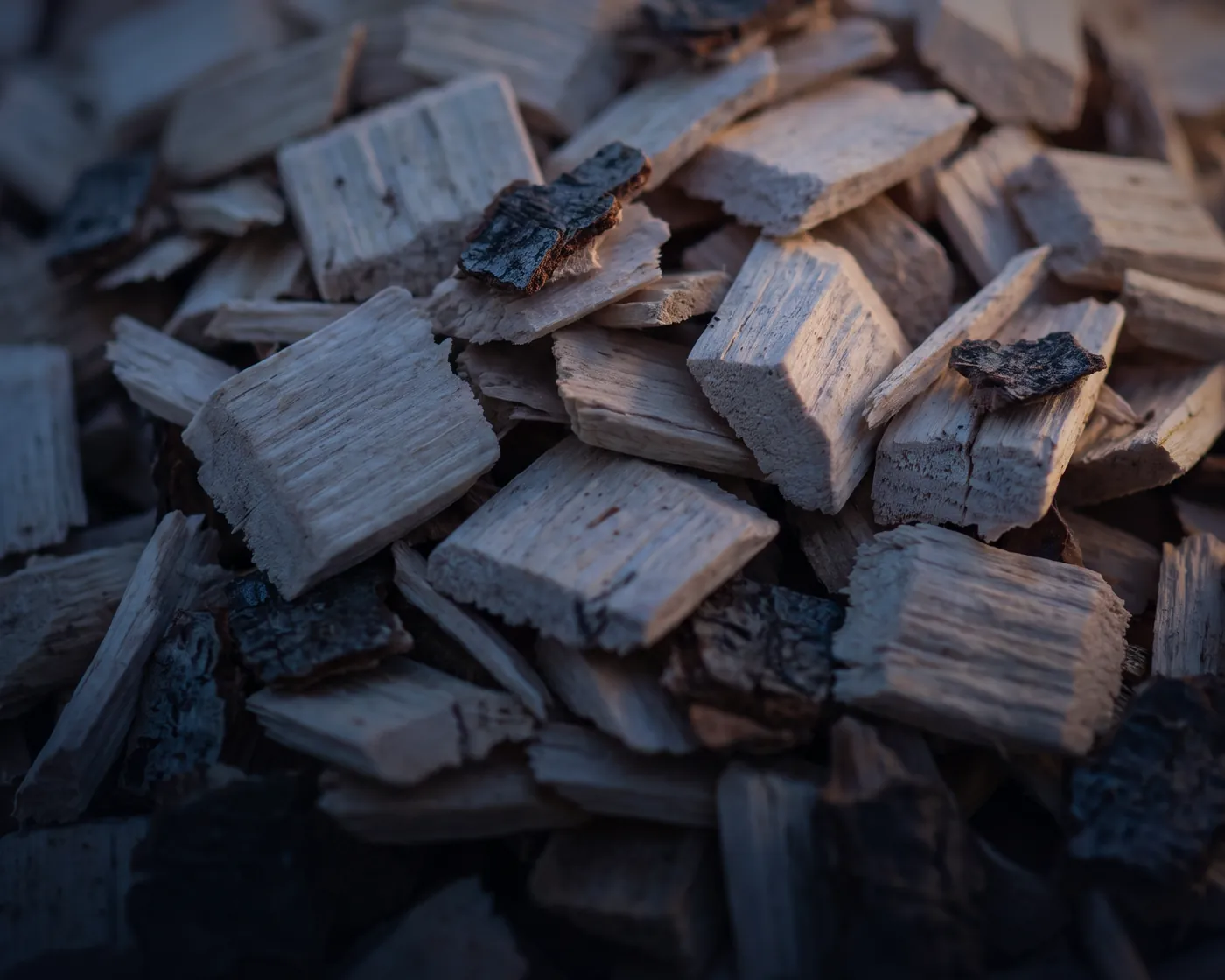
Horse manure holds 30–75 % moisture. The burner burns it at up to 60 % – and the moisture content is controlled by mixing in wood chips. In the mixer, wood chips and horse manure are blended to the right level before the fuel reaches the burners.
- Manure from the stalls
- 30–75 % moisture content
- The Biotherm burner
- Up to 60 %
- Moisture content controlled
- By mixing in wood chips
The Biotherm burner.

Biotherm's own burner, 250–1,000 kW, was developed together with Luleå University of Technology. We have worked with horse manure for over 20 years.
It burns horse manure, extremely wet wood chips and slaughterhouse waste, and can be adapted for wood chips, pellets, briquettes, sod peat and grain. The burner heats a boiler – a hot-water boiler, a high-temperature boiler with a steam generator, or a steam boiler.
From the store to the ash
The fuel is loaded into the stores outdoors. Conveyor screws carry it to the mixer and on into the burners, where it burns on the grate. The flue gases rise into the secondary channel and carry the energy into the boiler and its heat exchanger. Screws carry the ash out through the wall.
Manure that becomes pellets.
The manure can also be dried in our own dryer and pressed into pellets, which can be stored from summer to winter. From a 500 kW burner, approx. 130 kW goes to the dryer – the surplus heats the buildings.
- Before the dryer
- 30–70 % moisture content
- After the dryer
- 11–15 %
- The pellets
- approx. 5–7 %